
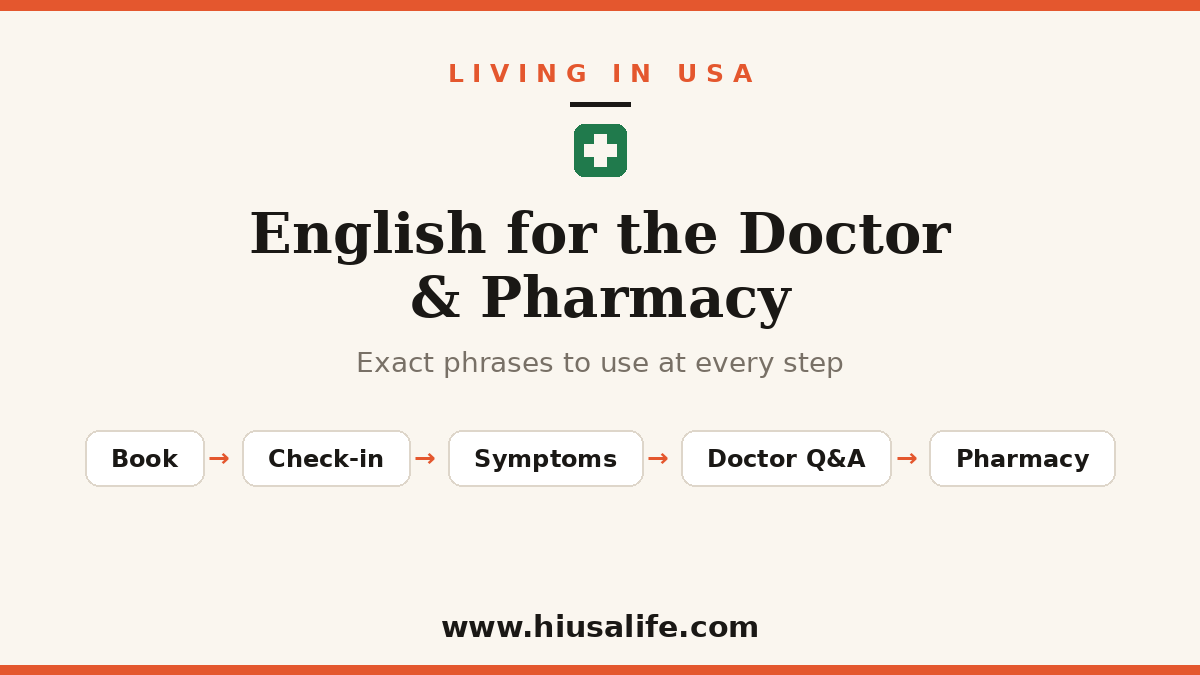

A doctor’s visit is stressful enough without a language barrier on top. The good news: medical English is one of the easiest situations to prepare for, because the conversation follows a predictable script every single time. Here is exactly what to say at each step — from booking to the pharmacy counter to the bill that shows up three weeks later.
Before You Go: Booking the Appointment
- “I’d like to make an appointment with Dr. ___.”
- “I’m a new patient.” / “I’m an existing patient.”
- “Are you in-network with my insurance? It’s ___.” (Ask it this way — “do you accept it” can mean they will bill it while still being out-of-network, which costs you far more.)
- “What’s the earliest available appointment?”
- “Is this covered, or will there be a copay?”
Which Place Do You Actually Need?
Choosing wrong is the most expensive mistake in this whole article. Primary care handles ongoing issues and checkups. Urgent care is for same-day problems that are not dangerous — a bad cough, a sprain, stitches — and costs a fraction of an emergency room. The ER is for chest pain, difficulty breathing, severe bleeding, or anything you think could be life-threatening, and it never turns anyone away. Many insurers also offer telehealth visits at low or no cost for simple problems.
What to Bring
Insurance card, photo ID, and a written list of every medication you take with its dose, plus your allergies. Photographing the pill bottles is enough. This one habit prevents more errors than any phrase on this page.
At Check-In
- “I have a 2 o’clock appointment with Dr. ___.”
- They will say: “Can I see your insurance card and ID?” — just hand them over.
- They may say: “Please fill out these forms” and “Have your copay ready.”
- If a form is unclear: “Could you help me with this part?”
Describing Symptoms (the part people dread)
You do not need medical vocabulary. Simple phrases work better. The pattern is “I have + symptom” or “My + body part + hurts.”
- “I have a fever / a cough / a headache / a sore throat / a runny nose.”
- “My stomach / back / chest hurts.”
- “It’s been hurting for three days.” (duration — they always ask)
- “The pain is sharp / dull / constant / comes and goes.” (type)
- “On a scale of 1 to 10, it’s about a 7.” (this exact question is coming)
- “It gets worse when I ___.” (movement, eating, lying down — very useful detail)
- “I’m allergic to ___.” (critical — always say this, even if not asked)
Questions to Ask the Doctor
- “What do you think is causing this?”
- “Do I need any tests?”
- “Are you prescribing medication? How do I take it?”
- “Are there any side effects I should watch for?”
- “When should I follow up?” and “What should make me call you sooner?”
- “Do I need a referral to see a specialist?” (HMO plans usually require one; PPOs often do not)
- If they speak too fast: “Could you say that more slowly, please?” or “Can you write that down?”
At the Pharmacy
- “I’m here to pick up a prescription for [your name].”
- “Is this covered by my insurance?” / “How much is the copay?”
- “Is there a generic version?” (same medicine, much cheaper — always ask)
- “Can you price it with and without insurance?” (the cash price is sometimes lower — pharmacists do this all day)
- “How many times a day do I take this? With food or without?”
- “How many refills do I have?” / “Can you transfer my prescription to another pharmacy?”
- “Can I get a flu shot here?” (U.S. pharmacies give many vaccines, usually without an appointment)
When the Bill Arrives
The bill comes weeks later and is often wrong. These four sentences are worth real money:
- “Can I get an itemized bill?” — line-by-line, where duplicate charges become visible.
- “Was this billed in-network?”
- “Can you set up a payment plan?” — most hospitals will, interest-free, and many have financial assistance programs you have to ask about by name.
- “I’d like to appeal this denial.” — insurers deny claims routinely and a large share of appeals succeed.
If you are uninsured or paying cash, you are entitled under the No Surprises Act to a written Good Faith Estimate of what non-emergency care will cost, before you receive it. Ask for it — providers do not always volunteer it, and if the final bill comes in substantially higher, there is a federal dispute process.
Words You’ll Hear a Lot
Copay (your fixed share) · Deductible (what you pay before insurance starts) · Coinsurance (your percentage after the deductible) · Out-of-pocket maximum (the annual ceiling) · In-network / out-of-network · Refill · Over-the-counter (OTC) · Primary care · Referral · Prior authorization (insurer approval before certain care) · EOB (Explanation of Benefits — not a bill, despite looking exactly like one).
💡 Tip: A free interpreter is your legal right at any provider receiving federal funding, under Title VI of the Civil Rights Act and Section 1557 of the Affordable Care Act — which covers nearly every hospital and clinic in the country. Say “I need an interpreter in ___” when you book, and again at check-in. It is not rude and it is not a favor; it is the law, and it is free to you.
One thing to avoid: do not use your child as your interpreter. It is common, it is understandable, and most hospital policies discourage or prohibit it — because medical vocabulary is hard, mistakes are dangerous, and it puts an unfair weight on a kid. Ask for the professional interpreter instead. And never nod along if you missed something important: “Sorry, I didn’t understand — could you explain that again?” is a completely normal thing to say.
Related reading: 12 Free Ways to Improve Your English · How to Save on Prescription Drugs
General language and information guidance as of August 2026, not medical or legal advice. In a real emergency, call 911.
#MedicalEnglish #ESL #EnglishPhrases #Healthcare #Pharmacy #PatientRights #MedicalBills #NoSurprisesAct #Interpreter #hiusalife
병원·약국 영어 (2026): 단계별로 그대로 쓰는 표현
병원 가는 것만으로도 긴장되는데 언어 장벽까지 있으면 더 힘들죠. 좋은 소식은, 의료 영어가 준비하기 가장 쉬운 영역이라는 겁니다. 대화가 매번 같은 순서로 흘러가거든요. 예약부터 약국, 그리고 3주 뒤에 날아오는 청구서까지 정리했습니다.
가기 전: 예약하기
- “I’d like to make an appointment with Dr. ___.” (___ 선생님께 예약하고 싶어요)
- “I’m a new patient.” (초진) / “I’m an existing patient.” (재진)
- “Are you in-network with my insurance? It’s ___.” — “accept”보다 이 표현을 쓰세요. 보험을 ‘받긴 받지만’ 네트워크 밖이면 본인 부담이 훨씬 커집니다
- “What’s the earliest available appointment?” (가장 빠른 예약이 언제예요?)
- “Is this covered, or will there be a copay?” (보험 처리되나요, 코페이가 있나요?)
어디로 가야 하나
잘못 고르는 게 이 글에서 가장 비싼 실수입니다. Primary care는 지속적인 문제와 검진, Urgent care는 위험하진 않은 당일 문제(심한 기침, 염좌, 봉합)이고 응급실의 일부 비용이면 됩니다. ER은 흡통·호흡곰란·심한 출혈 등 생명이 위험할 수 있는 경우이며, 누구든 거절하지 않습니다. 간단한 문제는 보험사가 제공하는 원격진료가 저렴합니다.
챙길 것
보험카드, 사진 신분증, 그리고 복용 중인 모든 약과 용량 목록, 알레르기 목록입니다. 약병을 사진 찍어가는 것으로 충분해요. 이 습관 하나가 어떤 표현보다도 많은 오류를 막아줍니다.
접수할 때
- “I have a 2 o’clock appointment with Dr. ___.” (2시 예약이에요)
- “Can I see your insurance card and ID?” (보험카드와 신분증 주세요) — 건네주면 됩니다
- “Please fill out these forms” (양식 작성해주세요), “Have your copay ready” (코페이 준비해주세요)
- 양식이 이해 안 되면: “Could you help me with this part?”
증상 설명하기
의학 용어 필요 없습니다. 기본 패턴은 “I have + 증상” 또는 “My + 부위 + hurts”입니다.
- “I have a fever / a cough / a headache / a sore throat / a runny nose.” (열/기침/두통/인후통/콧물)
- “My stomach / back / chest hurts.” (배/등/가슴이 아파요)
- “It’s been hurting for three days.” (3일째 아파요 — 기간은 반드시 물어봅니다)
- “The pain is sharp / dull / constant / comes and goes.” (찌르는/둔한/계속/왔다 갔다)
- “On a scale of 1 to 10, it’s about a 7.” (1~10 중 7 정도)
- “It gets worse when I ___.” (움직일 때, 먹을 때, 누우면 — 아주 유용한 정보예요)
- “I’m allergic to ___.” (알레르기는 묻지 않아도 먼저 말하세요)
의사에게 물어볼 질문
- “What do you think is causing this?” (원인이 뭘까요?)
- “Do I need any tests?” (검사가 필요한가요?)
- “Are there any side effects I should watch for?” (주의할 부작용은요?)
- “When should I follow up?” / “What should make me call you sooner?” (어떤 증상이면 더 빨리 연락해야 하나요?)
- “Do I need a referral to see a specialist?” (HMO는 보통 필요, PPO는 대개 불필요)
- 너무 빠르면: “Could you say that more slowly, please?” / “Can you write that down?”
약국에서
- “I’m here to pick up a prescription for [이름].”
- “Is there a generic version?” (제네릭 있나요? — 같은 약인데 훨씬 쌀니다)
- “Can you price it with and without insurance?” (보험 적용과 미적용 둘 다 계산해주시겠어요? — 현금가가 더 쌀 때가 있습니다)
- “How many times a day do I take this? With food or without?”
- “How many refills do I have?” / “Can you transfer my prescription to another pharmacy?”
- “Can I get a flu shot here?” (미국 약국은 예약 없이 백신 접종을 합니다)
청구서가 오면
청구서는 몇 주 뒤에 오고, 틀린 경우가 상당히 많습니다. 이 네 문장은 실제로 돈이 됩니다.
- “Can I get an itemized bill?” (항목별 청구서 — 중복 청구가 드러납니다)
- “Was this billed in-network?” (네트워크 내로 청구된 게 맞나요?)
- “Can you set up a payment plan?” — 대부분의 병원이 무이자 분할을 해주고, 이름을 대면 물어야 알려주는 재정 지원(financial assistance) 프로그램도 있습니다
- “I’d like to appeal this denial.” — 보험사는 일상적으로 거절하고, 이의신청은 상당수가 받아들여집니다
무보험이거나 현금 결제라면, No Surprises Act에 따라 응급이 아닌 진료의 비용을 미리 서면으로 받을 권리(Good Faith Estimate)가 있습니다. 먼저 안 줄 때가 많으니 요구하세요. 최종 청구가 크게 높으면 연방 분쟁 절차도 있습니다.
자주 듣게 될 단어
Copay(고정 본인부담금) · Deductible(보험 적용 전까지 본인 부담) · Coinsurance(디덕터블 이후 부담 비율) · Out-of-pocket maximum(연간 본인부담 상한) · In-network / out-of-network · Refill(재조제) · OTC(처방전 불필요) · Primary care(주치의) · Referral(전문의 의뢰서) · Prior authorization(사전 승인) · EOB(보험 내역서 — 청구서처럼 생겼지만 청구서가 아닙니다).
💡 팁: 연방 지원을 받는 의료기관 — 사실상 전국 대부분의 병원과 클리닉 — 에서 무료 통역은 법적 권리입니다. 민권법 Title VI와 ACA Section 1557에 근거해요. 예약할 때와 접수할 때 “I need a Korean interpreter”라고 말하세요. 부탁이 아니라 권리이고 비용도 없습니다.
피해야 할 것 하나 — 자녀를 통역으로 세우지 마세요. 흔하고 이해되는 일이지만 대부분의 병원 규정이 권장하지 않거나 금지합니다. 의학 용어는 어렵고, 오역은 위험하며, 아이에게 과도한 부담을 지웁니다. 전문 통역을 요청하세요. 그리고 중요한 걸 못 알아들었으면 절대 그냥 고개 끄덕이지 마세요.
함께 읽으면 좋은 글: 무료로 영어 공부하는 12가지 습관 · 미국 처방약 절약법
2026년 8월 기준 일반 언어·정보 가이드이며 의학·법률 자문이 아닙니다. 응급 상황에서는 911로 전화하세요.
#병원영어 #의료영어 #영어표현 #ESL #미국병원 #의료비 #환자권리 #무료통역 #미국생활정보 #hiusalife
댓글 남기기