
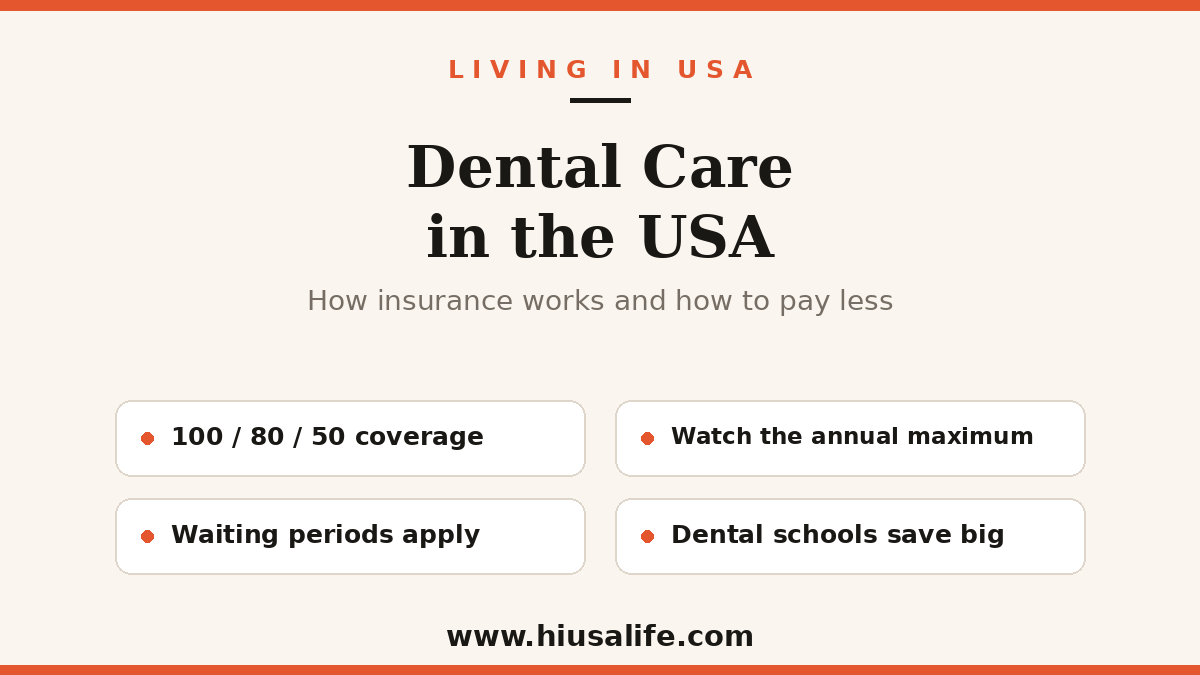

Dental insurance is the one kind of coverage that works backwards: it caps what the insurer pays, not what you pay. Understanding that single fact changes how you should use it — and often whether it is worth buying at all. Here is how the system works in 2026, with real numbers.
The 100 / 80 / 50 Structure
- Preventive — 90 to 100%. Cleanings, exams, X-rays, usually twice a year and often before the deductible.
- Basic — 70 to 80%. Fillings, simple extractions.
- Major — 50%. Crowns, root canals, bridges, dentures.
- Orthodontics — 0 to 25%, usually with its own separate lifetime maximum rather than counting against the annual one.
💵 The Annual Maximum Is the Whole Story
Most plans cap what the insurer will pay at $1,000 to $2,000 a year — $1,500 is the most common figure, and these caps have barely moved in decades while dental fees have not stopped rising. Premium plans offering $3,000 to $5,000 exist and cost accordingly.
Why that matters: a single molar root canal runs roughly $600 to $1,600, and the crown that back teeth usually need afterward adds $800 to $3,000. All-in on one molar can reach $1,690 to $4,500. One tooth can exhaust an entire year of benefits, and everything after that is yours.
Run the Math Before You Buy a Plan
Individual plans typically cost $300 to $600 a year in premiums plus a $50 to $150 deductible. So you may pay $350 to $750 before the plan contributes anything, against a ceiling of $1,000 to $1,500.
The honest conclusion: if you only need two cleanings a year, an individual plan is roughly a wash. If you need major work, the cap limits how much it helps anyway. Employer-sponsored dental is a different calculation — the employer subsidy usually makes it clearly worth taking.
⚠️ Five Clauses That Cost People Money
- Waiting periods. Major work is often not covered for 6 to 12 months after enrolling. But many insurers waive the waiting period if you had continuous prior dental coverage — always ask, and bring proof.
- The plan pays a percentage of its allowed amount, not your dentist’s fee. “50% covered” on a $2,000 crown does not mean $1,000 if the plan’s allowed amount is $1,200. Out-of-network providers widen that gap, and specialists like endodontists are disproportionately out-of-network.
- The LEAT clause. Many plans pay only for the least expensive alternative treatment — the amalgam filling rather than the composite, the extraction rather than the root canal. You can still choose the better option; you just pay the difference.
- The missing tooth clause. Teeth already missing when your coverage began are often excluded from replacement benefits entirely, sometimes permanently.
- Frequency limits. Two cleanings per twelve months, certain X-rays only every three to five years. Going early means paying full price even for covered services.
Ways to Pay Less
- Use the preventive benefit. It is the fully covered part, and it is what prevents the expensive work. Skipping cleanings is how a $150 problem becomes a $1,500 one.
- Dental schools. Supervised students provide care at a steep discount — often 30–60% below private practice. Appointments take longer, but faculty oversee everything, which makes it an excellent option for major treatment.
- Community health centers. Many federally qualified health centers offer dental on a sliding scale based on income.
- Dental savings plans. Not insurance — an annual fee buys discounted rates at participating dentists. No annual maximum and no waiting period, which can beat insurance outright if you need major work now.
- Ask for the cash price and a payment plan. Many offices quietly discount for payment up front, and most will spread treatment over months interest-free.
- Use FSA or HSA dollars — dental costs are eligible, so you are paying with pre-tax money, which is effectively a 20–30% discount depending on your bracket.
Coverage Situations Worth Knowing
- Medicare does not cover routine dental. No cleanings, fillings, crowns, or dentures under Original Medicare. Many Medicare Advantage plans include a dental benefit, though often with a modest annual allowance — check the actual dollar limit, not just the checkbox.
- Children are covered far better than adults. Pediatric dental is an essential health benefit under the ACA, and Medicaid and CHIP cover children’s dental in every state. Adult Medicaid dental varies enormously state to state.
- Families: look for separate per-person annual maximums rather than a shared family cap, so one person’s crown does not consume everyone’s benefit.
Before Any Big Treatment
Ask your dentist to submit a pre-treatment estimate to your insurer. You get in writing what is covered and what you will owe before work starts. Ask for the CDT procedure codes too — quoting them to your insurer confirms which coverage tier applies, which is where surprises usually hide. And for anything expensive, a second opinion is normal and expected; treatment plans genuinely differ between offices.
💡 Tip: If your plan has an annual maximum and you need extensive work, ask whether treatment can be split across two calendar years — finishing one phase in December and the next in January effectively doubles your benefit. Dentists do this routinely when asked, and nobody offers it unprompted.
Related reading: Medicare Explained (2026) · How to Save on Prescription Drugs
Cost figures are 2026 national ranges compiled from published payer and provider fee data; your prices will vary by region and provider. General information, not medical or insurance advice.
#DentalInsurance #DentalCare #Healthcare #AnnualMaximum #DentalSchool #HSA #SaveMoney #hiusalife
미국 치과 진료와 보험 (2026): 구조와 비용 줄이는 법
치과보험은 거꾸로 작동하는 유일한 보험입니다. 내가 내는 돈이 아니라 보험사가 내주는 돈에 상한을 둡니다. 이 사실 하나만 알아도 보험을 쓰는 방식이 바뀌고, 심지어 가입 여부까지 달라집니다. 2026년 실제 숫자와 함께 정리했습니다.
100 / 80 / 50 구조
- 예방 — 90~100%. 스케일링, 검진, 엑스레이. 보통 연 2회, 자기부담금 전에 적용되는 경우가 많습니다
- 기본 — 70~80%. 충전, 단순 발치
- 주요 — 50%. 크라운, 신경치료, 브리지, 틀니
- 교정 — 0~25%. 보통 연간 한도와 별도로 평생 한도가 있습니다
💵 결국 연간 한도가 전부입니다
대부분의 플랜이 보험사 지급액을 연 $1,000~$2,000으로 묶습니다. $1,500이 가장 흔하고, 치과 수가는 계속 올랐는데 이 상한은 수십 년간 거의 그대로입니다. $3,000~$5,000짜리 고급형도 있지만 보험료가 그만큼 비쌉니다.
왜 중요하냐 — 어급치 신경치료 하나가 $600~$1,600이고, 어급치는 그 뒤에 크라운이 필요해서 $800~$3,000이 더 붙습니다. 치아 하나에 $1,690~$4,500까지 나옵니다. 치아 하나로 1년치 보장이 끝나고, 그 뒤는 전액 본인 부담입니다.
가입 전에 계산해보세요
개인 플랜은 보통 연 $300~$600의 보험료에 $50~$150의 자기부담금이 붙습니다. 즉 보험사가 한 푼 내기 전에 $350~$750을 먼저 내고, 그 대가로 받을 수 있는 최대가 $1,000~$1,500입니다.
솔직한 결론은 이렇습니다. 연 2회 스케일링만 받는다면 개인 플랜은 거의 본전이고, 큰 치료가 필요하면 어차피 상한 때문에 도움이 제한적입니다. 다만 회사 제공 치과보험은 계산이 다릅니다 — 회사 분담금이 있어서 대개 드는 게 명백히 이득입니다.
⚠️ 돈이 새는 약관 다섯 가지
- 대기 기간. 주요 치료는 가입 후 6~12개월 보장되지 않는 경우가 많습니다. 다만 이전에 치과보험을 끊김없이 가지고 있었다면 대기 기간을 면제해주는 보험사가 많으니 증빙을 챙겨 꼭 물어보세요
- 보험사는 자기 기준 금액(allowed amount)의 비율을 냅니다. 치과 청구액이 아닙니다. $2,000짜리 크라운에 “50% 보장”이어도 기준 금액이 $1,200이면 $600만 나옵니다. 네트워크 밖 병원은 차이가 더 벌어지고, 근관치료 전문의는 네트워크 밖인 경우가 유독 많습니다
- LEAT 조항. 많은 플랜이 가장 저렴한 대안 치료 기준으로만 지급합니다 — 레진 대신 아말감, 신경치료 대신 발치 기준으로요. 더 나은 치료를 고를 수는 있지만 차액은 본인 부담입니다
- 결손치 조항(missing tooth clause). 보험 가입 시점에 이미 없던 치아는 수복 보장에서 아예 제외되는 경우가 많습니다
- 빈도 제한. 12개월당 스케일링 2회, 특정 엑스레이는 3~5년에 한 번. 일찍 가면 보장 항목이어도 전액을 냅니다
비용 줄이는 방법
- 예방 진료를 꼭 받으세요. 전액 보장되는 부분이고 비싼 치료를 막아줍니다. $150짜리 문제가 $1,500이 되는 경로가 바로 스케일링 건너뛰기입니다
- 치과대학 병원. 교수 감독 아래 학생 진료로 개인 치과 대비 30~60% 저렴한 경우가 많습니다. 시간은 오래 걸리지만 큰 치료에는 훌륭한 선택입니다
- 커뮤니티 헬스센터. 소득에 따른 차등 요금으로 치과 진료를 제공하는 곳이 많습니다
- 덴탈 세이빙스 플랜. 보험이 아니라 연회비를 내고 제휴 치과에서 할인받는 방식입니다. 연간 한도도 대기 기간도 없어 당장 큰 치료가 필요하면 보험보다 나을 수 있습니다
- 현금가와 분할 납부를 물어보세요. 선결제 할인을 조용히 해주는 곳이 많고, 무이자 분할도 흔합니다
- FSA·HSA를 쓰세요 — 치과 비용은 적격이라 세전 자금으로 내는 셈이고, 세율에 따라 사실상 20~30% 할인입니다
알아두면 좋은 보장 상황
- 메디케어는 일반 치과를 보장하지 않습니다. 오리지널 메디케어로는 스케일링·충전·크라운·틀니 모두 안 됩니다. 메디케어 어드밴티지에는 치과 혜택이 들어있는 경우가 많지만 연간 한도가 낮은 경우가 많으니 금액을 확인하세요
- 아이들은 성인보다 훨씬 잘 보장됩니다. 소아 치과는 ACA 필수 건강 혜택이고, 메디케이드와 CHIP은 모든 주에서 아동 치과를 커버합니다. 성인 메디케이드 치과는 주별 편차가 큽니다
- 가족 플랜은 공동 한도가 아니라 1인당 별도 연간 한도인지 확인하세요. 한 사람 크라운으로 가족 전체 보장을 다 써버리면 곳란합니다
큰 치료 전에 꼭
치과에 사전 견적(pre-treatment estimate)을 보험사에 제출해달라고 요청하세요. 치료 시작 전에 보장 범위와 본인 부담액을 서면으로 받게 됩니다. CDT 시술 코드도 함께 받아두세요 — 보험사에 코드를 대면 어느 보장 등급인지 확인되는데, 보통 여기서 문제가 생깁니다. 비싼 치료라면 2차 소견은 아주 일반적입니다.
💡 팁: 연간 한도가 있는데 치료량이 많다면 두 해에 걸쳐 나누어 받을 수 있는지 물어보세요 — 12월에 1단계, 1월에 2단계면 보장 한도를 사실상 두 배로 쓰는 셈입니다. 요청하면 치과에서 흔히 해주는데, 먼저 제안해주는 곳은 없습니다.
함께 읽으면 좋은 글: 메디케어 완전 정리 · 미국 처방약 절약법
비용은 2026년 전국 범위이며 지역·병원에 따라 다릅니다. 일반 정보이며 의료·보험 자문이 아닙니다.
#치과보험 #미국치과 #연간한도 #치료비절약 #치과대학병원 #HSA #미국의료 #미국생활정보 #hiusalife
댓글 남기기