
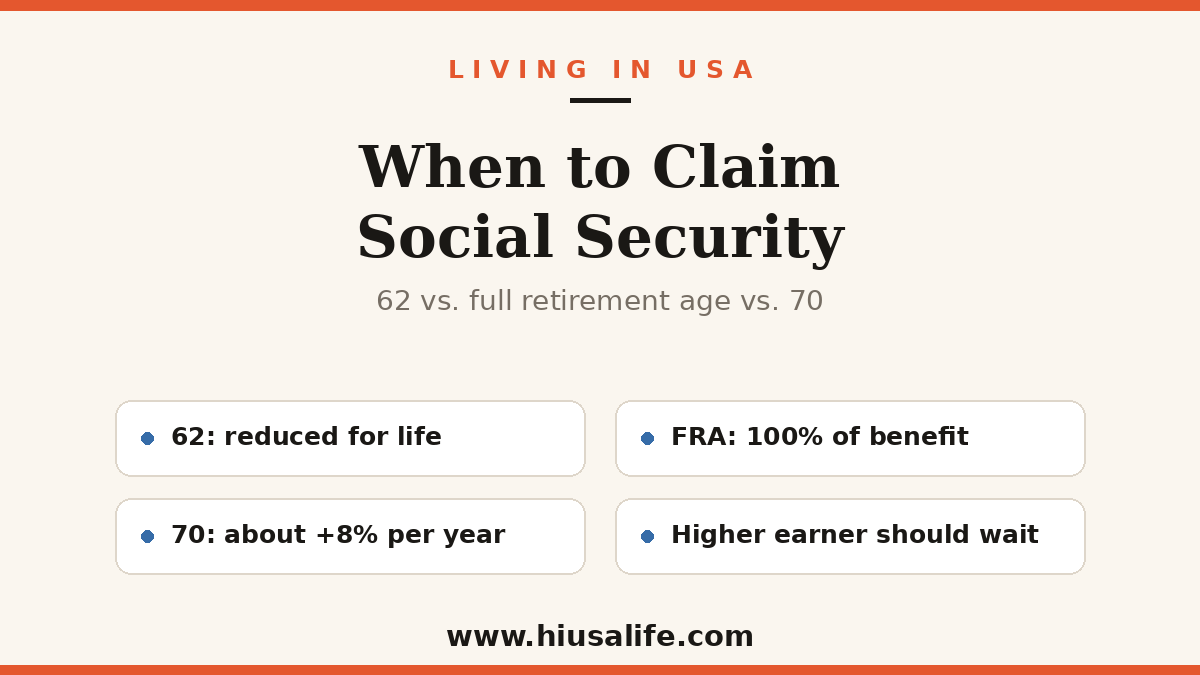
Deciding when to start Social Security is one of the largest financial decisions of your life, and it’s mostly irreversible. The difference between claiming at 62 and at 70 can be tens of thousands of dollars over a retirement. Here’s the framework.
The Three Ages That Matter
- 62 — the earliest you can claim. Your monthly benefit is permanently reduced, by roughly 25–30% depending on your birth year.
- Full Retirement Age (FRA) — 66 to 67 for most people today. Claim here and you receive 100% of your calculated benefit.
- 70 — the latest worth waiting for. Each year you delay past FRA adds delayed retirement credits, increasing the check by about 8% per year. After 70 there’s no further increase, so there’s no reason to wait longer.
Reasons to Claim Early
You need the income now; you have health concerns that shorten your expected horizon; you’d otherwise drain retirement savings that could keep growing; or you’re stopping work anyway and the bridge matters more than the maximum. Claiming early is not a mistake — it’s a trade-off, and for many households it’s the right one.
Reasons to Wait
You’re still working and don’t need it; you’re in good health with longevity in the family; or you’re the higher earner in a couple — that last one matters more than people realize, because your benefit often becomes the survivor benefit for whichever spouse lives longer. Delaying the larger check protects the survivor.
Two Rules People Get Wrong
- The earnings test. If you claim before FRA and keep working, benefits are temporarily withheld above an annual earnings limit. Those amounts are recalculated later, but the surprise catches people off guard.
- Benefits can be taxable. Depending on your total income, a portion of your Social Security may be subject to federal income tax — and some states tax it too.
💡 Tip: Create a my Social Security account at ssa.gov and look at your personalized estimates for every claiming age, plus your earnings record. Errors in your earnings history reduce your benefit and are far easier to fix now than at 66. This is free and takes fifteen minutes.
Related reading: Social Security 40 Credits · 2026 Retirement Account Limits
General information as of July 2026, not financial advice. Rules, limits, and formulas change — confirm your situation with the Social Security Administration.
#SocialSecurity #Retirement #ClaimingAge #LivingInUSA #USALife #PersonalFinance #hiusalife
소셜시큐리티를 언제부터 받을지는 인생에서 가장 큰 재정 결정 중 하나이고, 대부분 되돌릴 수 없어요. 62세 수령과 70세 수령의 차이는 은퇴 기간 전체로 보면 수만 달러가 됩니다. 판단 기준을 정리했어요.
중요한 세 가지 나이
- 62세 — 가장 빨리 받을 수 있는 나이. 출생연도에 따라 월 수령액이 대략 25~30% 영구적으로 줄어요.
- 완전은퇴연령(FRA) — 요즘 대부분 66~67세. 이때 받으면 계산된 금액의 100%를 받습니다.
- 70세 — 기다릴 값어치가 있는 마지막 나이. FRA 이후 1년 미룰 때마다 약 8%씩 늘어요. 70세 넘으면 더 늘지 않으니 더 기다릴 이유가 없습니다.
일찍 받는 게 맞는 경우
지금 소득이 필요한 경우, 건강 문제로 기대 수명이 짧아진 경우, 안 받으면 계속 불어날 은퇴 저축을 깨야 하는 경우, 또는 어차피 일을 그만두는데 ‘지금의 다리’가 ‘최대 금액’보다 중요한 경우예요. 일찍 받는 게 실수는 아니에요 — 트레이드오프이고, 많은 가정에는 그게 정답입니다.
미루는 게 맞는 경우
아직 일하고 있어 필요하지 않은 경우, 건강하고 집안에 장수 이력이 있는 경우, 또는 부부 중 소득이 더 높은 쪽인 경우예요. 마지막이 생각보다 중요한데, 내 수령액이 나중에 더 오래 사는 배우자의 유족연금이 되는 경우가 많기 때문이에요. 큰 쪽을 미뤄두면 남은 배우자를 보호하게 됩니다.
사람들이 틀리는 두 가지
- 소득 심사(earnings test). FRA 전에 받으면서 계속 일하면, 연간 소득 한도를 넘는 만큼 연금이 일시 보류돼요. 나중에 재계산되지만 모르고 당하면 당황스럽습니다.
- 연금도 과세될 수 있어요. 전체 소득에 따라 소셜시큐리티의 일부가 연방 소득세 대상이 되고, 일부 주는 주세도 매깁니다.
💡 팁: ssa.gov에서 my Social Security 계정을 만들어 수령 나이별 예상액과 내 소득 기록을 확인하세요. 소득 기록에 오류가 있으면 수령액이 줄어드는데, 66세에 발견하는 것보다 지금 고치는 게 훨씬 쉬워요. 무료이고 15분이면 됩니다.
함께 읽으면 좋은 글: 소셜시큐리티 40 크레딧 · 2026 은퇴계좌 한도
2026년 7월 기준 일반 정보이며 재정 자문이 아닙니다. 규정·한도·산식은 바뀌니 본인 상황은 소셜시큐리티국에 확인하세요.
#소셜시큐리티 #미국은퇴 #연금수령시기 #미국생활 #미국생활정보 #노후준비 #hiusalife
댓글 남기기