
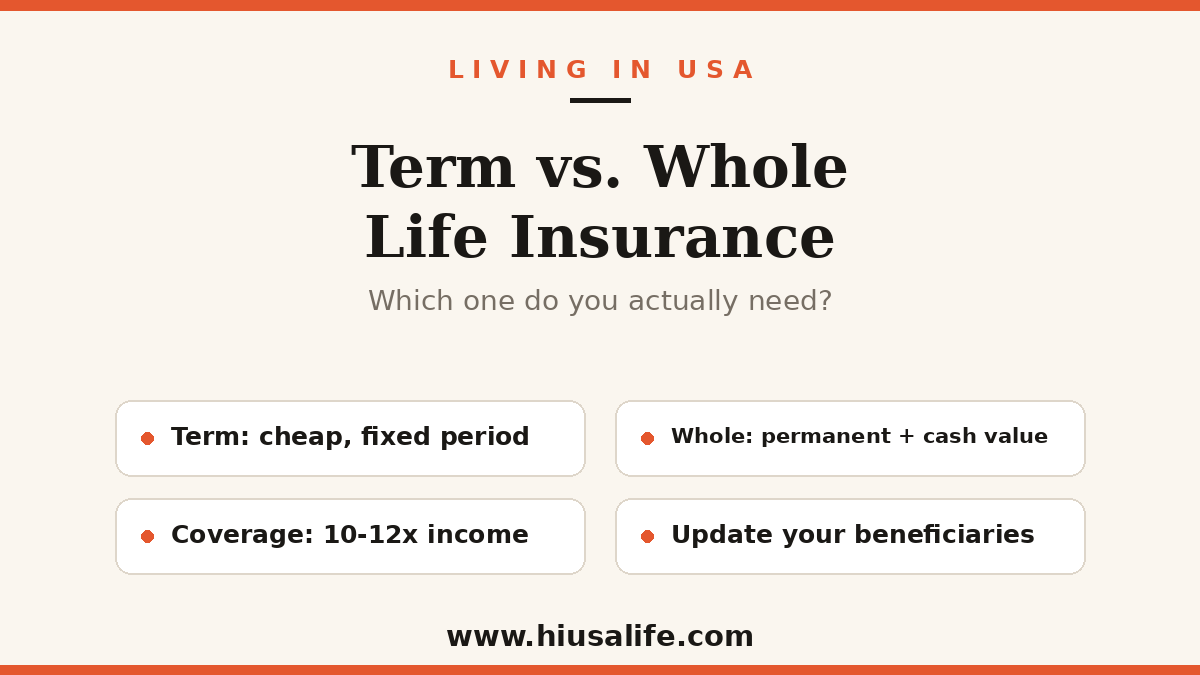

Nobody explains life insurance until an agent is selling you the expensive version. The core question is simple: if your income disappeared tomorrow, who would struggle? If the answer is nobody, you may not need it yet. If someone depends on you, here is how to buy it without overpaying — with the 2026 numbers that make the choice obvious.
Term Life: Simple and Cheap
Term covers you for a set period — usually 10, 20, or 30 years — at a premium that stays level the whole time. Die during the term and your beneficiaries get the payout, generally income-tax-free. Outlive it and the policy simply ends. There is no investment component, which is exactly why it is cheap.
Whole Life: Permanent, With a Savings Component
Whole life never expires and builds cash value you can borrow against. Universal life is similar but lets you adjust premiums and death benefit. Both are permanent, both build cash value — and both cost multiples of term for the same death benefit. Agents earn far larger commissions on them, which is why they get pushed hard.
💵 The Price Gap, in Actual Dollars
This is the part that settles most people’s decision. For a $500,000 policy on a healthy 40-year-old non-smoker, 2026 market averages look roughly like this:
- 20-year term: about $59/month for men, $47/month for women
- Universal life: about $362/month — roughly six times the term price
- Whole life: about $574/month
That is a gap of roughly $515 a month, or $6,180 a year. Over 30 years it comes to about $185,400 in extra premium. The whole life policy does build cash value — commonly in the $60,000–$90,000 range after 20 years — but analyses consistently find that investing the difference in a tax-advantaged account produces substantially more wealth over the same period.
For most people whose goal is replacing income, that comparison is the whole argument.
When Whole Life Genuinely Does Make Sense
It is a real product with real uses, just not the ones it is usually sold for. Permanent coverage is worth the premium if you:
- Have already maxed out your 401(k), IRA, and HSA and want another tax-deferred bucket
- Have an estate large enough to face federal or state estate tax and need liquidity to pay it
- Support a dependent with lifelong needs, where coverage must not expire
- Own a business with a buy-sell agreement that has to be funded
If none of those describe you, term almost certainly wins.
Your Health Class Is Worth More Than Shopping
The same 40-year-old man buying the same $500,000 20-year policy pays about $28 a month at Preferred Plus and $54 at Standard — a 93% difference for identical coverage. Smoking pushes the average to roughly $194 a month.
Two things follow. First, if you are close to a better health class — a few pounds, a blood pressure reading, a year smoke-free — it can be worth waiting a few months. Second, carriers rate conditions differently, so an independent agent who can shop multiple companies matters more than a brand name.
Waiting Costs About 8–10% a Year
Buying at 30 instead of 40 saves roughly $17 a month on the same policy; 30 instead of 50 is closer to $100 a month. Rates lock in at purchase and never rise during the term, so the premium you get at 32 is the premium you keep until 52. There is no reason to wait for a healthy person who already has dependents.
How Much Coverage Do You Need?
- A common starting point: 10–12× your annual income.
- Add what you want covered: remaining mortgage, children’s education, final expenses.
- Subtract what already exists: savings, your spouse’s income, employer coverage.
- Match the term to the need — if your youngest is 3, a 20-year term carries you until they are independent.
- Don’t skip the stay-at-home parent. Replacing full-time childcare and household work costs real money, and that policy is cheap.
The Fine Print Worth Knowing
- The conversion option. Most 20-year term policies let you convert to permanent coverage later without a new medical exam. If you develop a health condition, that clause can be priceless — check that your policy has it and when the window closes.
- What happens at the end of the term. Many policies renew annually afterward at rates that climb steeply every year. It is a safety net, not a plan.
- Riders worth asking about: waiver of premium (the insurer pays if you become disabled), accelerated death benefit (access to part of the payout if you are terminally ill — often included free), and a child rider.
- The two-year contestability period. Within the first two years an insurer can investigate and deny a claim over a misstatement on the application. This is why honesty on the health questions is not optional.
- The free look period. After signing you generally have 10 to 30 days to cancel for a full refund. If an agent is rushing you, you have more time than they are implying.
Mistakes That Cost People Money
- Relying only on work coverage. Employer life insurance usually ends the day the job does, and is often just 1–2× salary. Ask about portability or conversion before you leave.
- Buying whole life as an investment before filling tax-advantaged accounts.
- Surrendering a whole life policy early. Cash value is minimal in the first years and surrender charges are steep, so buyers who abandon these policies often lose most of what they paid in.
- Forgetting to name and update beneficiaries. The beneficiary form controls the money — not your will. Update it after a marriage, divorce, or birth.
- Return-of-premium term. It sounds like free insurance and generally costs enough extra that investing the difference wins again.
💡 Tip: Get quotes from at least three insurers — the spread on identical coverage is wide, and wider still with any health history. Ask specifically whether the quote is after underwriting or before; the attractive number in an ad is usually a Preferred Plus rate most applicants will not receive. And answer every medical question honestly, because a misstatement can void a claim precisely when your family needs it.
Related reading: 2026 Retirement Account Limits · Homeowners vs. Renters Insurance
Rates cited are 2026 market averages for applicants in average health and are illustrations, not quotes — your price depends on age, health, and carrier. General information only, not financial advice.
#LifeInsurance #TermLife #WholeLife #FinancialPlanning #PersonalFinance #InsuranceTips #FamilyFinance #hiusalife
정기보험 vs 종신보험 (2026): 어느 쪽이 진짜로 필요한가
생명보험은 에이전트가 비싼 상품을 팔기 전까진 아무도 설명해주지 않습니다. 핵심 질문은 단순합니다 — 내 소득이 내일 사라지면 누가 곤란해지나요? 답이 “아무도”라면 아직 필요 없을 수도 있습니다. 기대는 사람이 있다면, 2026년 실제 숫자로 판단하는 법을 정리했습니다.
Term(정기보험): 단순하고 저렴
Term은 정해진 기간(보통 10·20·30년) 동안 보험료가 고정된 채 보장합니다. 기간 중 사망하면 수익자가 보험금을 받고 이는 원칙적으로 소득세 비과세입니다. 기간을 넘기면 계약은 그냥 끝납니다. 투자 요소가 없어서 싸것입니다.
Whole(종신보험): 평생 보장 + 저축 기능
Whole life는 만기가 없고 현금가치가 쌓여 대출도 가능합니다. Universal life는 비슷하되 보험료와 보험금을 조정할 수 있습니다. 둘 다 같은 사망보험금 기준으로 Term의 몇 배입니다. 에이전트 수수료가 훨씬 크기 때문에 강하게 권유받는 상품이기도 합니다.
💵 가격 차이를 실제 금액으로
대부분의 선택을 결정짓는 대목입니다. 건강한 40세 비흡연자, 보장금액 $500,000 기준 2026년 시장 평균입니다.
- 20년 Term: 남성 약 월 $59, 여성 약 월 $47
- Universal life: 약 월 $362 — Term의 약 6배
- Whole life: 약 월 $574
차이가 월 $515, 연 $6,180입니다. 30년이면 약 $185,400을 더 내는 셈입니다. 종신보험은 20년쯤 지나면 보통 $60,000~$90,000의 현금가치가 쌓이지만, 그 차액을 세금 혜택 계좌에 투자했을 때가 같은 기간 기준 훨씬 유리하다는 분석이 일관됩니다.
그래도 종신보험이 맞는 경우
쓸모가 있는 상품입니다. 다만 보통 팔리는 이유와는 다릅니다. 401(k)·IRA·HSA를 이미 다 채운 경우, 상속세 대상이 될 만큼 자산이 큰 경우, 평생 돌봐야 할 부양가족이 있어 보장이 만료되면 안 되는 경우, 그리고 사업체 지분 매매 계약 재원이 필요한 경우입니다. 해당되는 게 없다면 Term이 거의 확실히 유리합니다.
보험사보다 건강등급이 더 큽니다
같은 40세 남성이 같은 $500,000 20년 상품을 사는데, Preferred Plus면 월 약 $28, Standard면 $54입니다. 동일 보장에 93% 차이입니다. 흡연자는 평균이 월 $194까지 올라갑니다. 따라서 등급 경계선에 가깝다면(체중 몇 파운드, 혈압 수치, 금연 1년) 몇 달 기다렸다 가입하는 게 낫고, 보험사마다 질병 평가가 달라서 여러 곳을 비교해주는 독립 에이전트가 브랜드보다 중요합니다.
미룰 때마다 연 8~10%씩
같은 상품을 40세 대신 30세에 사면 월 약 $17, 50세 대신 30세면 월 약 $100 차이입니다. 보험료는 가입 시점에 고정되어 기간 내내 오르지 않으니, 32세에 받은 요율을 52세까지 가져갑니다. 부양가족이 이미 있는 건강한 사람이 미룰 이유가 없습니다.
얼마나 가입해야 할까
- 출발점: 연소득의 10~12배
- 더할 것: 남은 모기지, 자녀 학비, 장례 비용
- 벀 것: 저축, 배우자 소득, 회사 제공 보험
- 보장 기간을 필요 기간에 맞추세요 — 막내가 3살이면 20년이 자립할 때까지 커버합니다
- 전업으로 육아하는 배우자도 빼지 마세요. 종일 보육과 가사를 대체하는 비용은 상당하고, 보험료는 쌀니다
알아두면 좋은 약관
- 전환권(conversion option). 대부분의 20년 Term은 나중에 건강검진 없이 종신형으로 전환할 수 있게 해둡니다. 병이 생기면 값을 매길 수 없는 조항이니, 있는지와 기한을 확인하세요
- 만기 이후. 연 단위로 자동 갱신되지만 보험료가 해마다 가파르게 오릅니다. 계획이 아니라 안전망입니다
- 물어볼 만한 특약: 보험료 납입면제(장애 시 보험사가 대납), 사망보험금 선지급(말기 진단 시 일부 수령 — 무료 포함이 많음), 자녀 특약
- 2년 부재기간. 가입 후 2년 안에는 청약서 허위 기재를 이유로 보험금을 거절할 수 있습니다
- 청약철회(free look). 서명 후 보통 10~30일은 전액 환불 취소가 가능합니다. 에이전트가 서두르게 해도 시간은 있습니다
돈이 새는 실수들
- 회사 보험만 믿기. 퇴사하는 날 끝나고 금액도 연봉의 1~2배 수준입니다. 그만두기 전에 이전·전환 가능 여부를 물어보세요
- 종신보험을 “투자”로 사기 — 세금 혜택 계좌를 먼저 채우는 게 순서입니다
- 종신보험 조기 해약. 초기엔 현금가치가 거의 없고 해약공제액이 커서 낸 돈의 대부분을 잃습니다
- 수익자 지정·갱신을 잊기. 유언장이 아니라 수익자 지정서가 돈의 향방을 결정합니다. 결혼·이혼·출산 후 갱신하세요
- 보험료 환급형 Term. 공짜 보험처럼 들리지만 추가 보험료를 감안하면 역시 차액 투자가 이깁니다
💡 팁: 최소 세 곳에서 견적을 받으세요. 그리고 그 견적이 심사 전인지 후인지를 꼭 확인하세요 — 광고에 나오는 숫자는 대부분 Preferred Plus 요율이라 실제 받는 사람은 적습니다. 건강 질문에는 정직하게 답하세요. 사실과 다르면 정작 가족이 필요할 때 보험금이 거절될 수 있습니다.
함께 읽으면 좋은 글: 2026 은퇴계좌 한도 · 주택보험 vs 렌터스보험
인용한 보험료는 2026년 평균 건강 기준 시장 평균이며 예시일 뿐 견적이 아닙니다. 일반 정보이며 재정 자문이 아닙니다.
#생명보험 #정기보험 #종신보험 #미국보험 #보험료비교 #재정계획 #미국생활정보 #hiusalife
댓글 남기기