
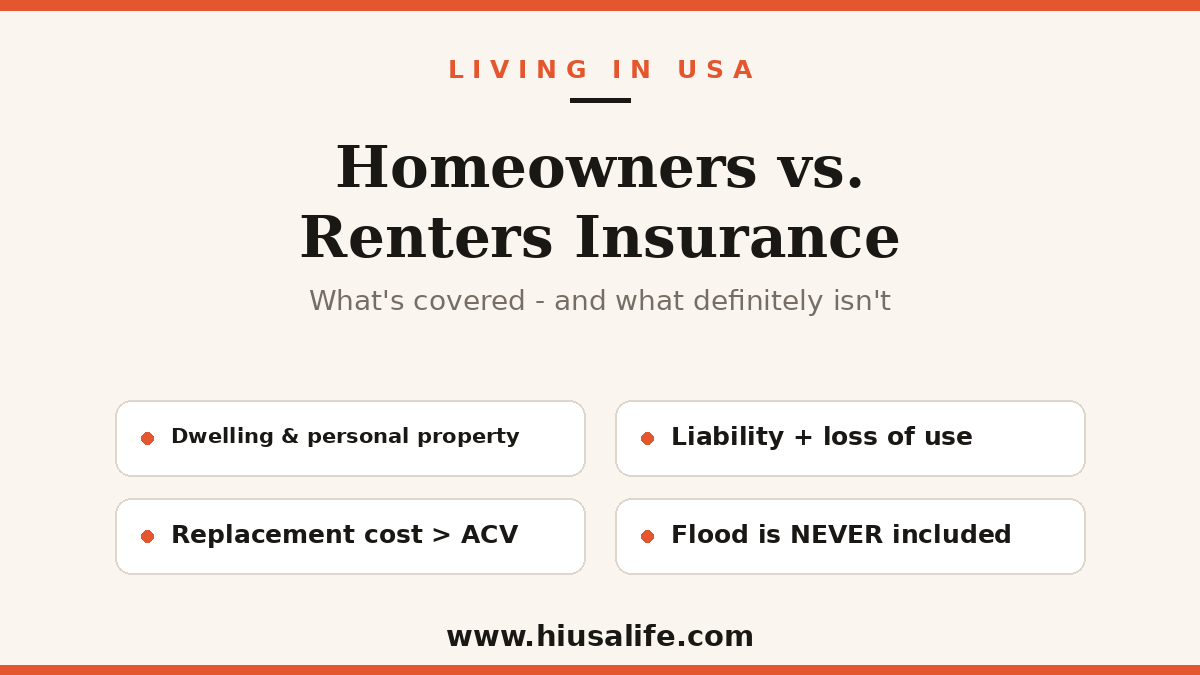

Renters insurance costs about as much as a few coffees a month, and most renters skip it anyway. Homeowners insurance is required by your lender, and almost nobody reads it. Both protect far more than people realize, both have exclusions that catch families at the worst moment — and in 2026 the price of one of them has become a housing-affordability problem in its own right.
💵 What They Cost Now
- Renters insurance: roughly $13 to $23 a month depending on the state and coverage — about $150 to $275 a year.
- Homeowners insurance: estimates range from about $2,490 a year (NerdWallet, for $400,000 dwelling and $300,000 liability) to projections near $3,000 by the end of 2026 — a 4% rise on top of a sharp 12% increase in 2025.
A Pew survey this year found 71% of U.S. homeowners say their insurance costs have risen in recent years. If you are buying a home, treat insurance as a line item in affordability from the first search, not a detail at closing — in the highest-cost states it can exceed $500 a month.
Why Your Rate Rises Even With No Claims
The thing that confuses people: your premium is based on what it costs to rebuild your house, not what the house is worth. When lumber, roofing, and labor get more expensive, your coverage limit rises automatically and the premium follows — no claim required.
That is why 2026 has been rough. A 50% Section 232 tariff on imported steel and aluminum remains in effect, and tariffs on cabinets, vanities, and upholstered goods rose on January 1, 2026. Analysts estimate construction-material tariffs alone could add roughly $106 to the average annual premium.
The other pressure is availability. Treasury data shows nonrenewal rates are about 80% higher in the highest-risk ZIP codes, and California’s FAIR Plan — the state’s insurer of last resort — has grown to nearly 700,000 policies as private carriers retreat. In wildfire, hurricane, and hail country, the question is increasingly whether you can get covered, not just at what price.
What Each One Actually Covers
- Dwelling (homeowners only) — the structure. Your landlord’s policy covers the building; it does not cover your belongings.
- Personal property (both) — furniture, electronics, clothes. On a homeowners policy this is usually set automatically at 50–70% of the dwelling limit, which may or may not match what you own.
- Liability (both) — the part people most underestimate. Policies often default to $100,000; $300,000 to $500,000 costs little more and is the realistic number.
- Loss of use (both) — hotel and meal costs if your home becomes unlivable after a covered loss.
Renters: The Reason That Actually Matters
Most renters think of it as covering a stolen laptop. The bigger reason is liability. If a fire starts in your unit — a candle, a space heater, a forgotten stove — and it damages the building or your neighbors’ apartments, the landlord’s insurer can come after you for the cost. That is a six-figure exposure, and it is the single strongest argument for a $15-a-month policy.
Replacement Cost vs. Actual Cash Value
This one setting can change your payout dramatically. Replacement cost pays what the item costs new today. Actual cash value pays the depreciated value — a five-year-old laptop is worth very little on paper. For renters the upgrade usually costs $3–5 a month and is almost always worth it.
One place this quietly bites homeowners: roofs. Many carriers now pay only actual cash value on roofs past a certain age, and some states allow it broadly. A hail claim on a fifteen-year-old roof can pay a fraction of what a replacement costs. Check how your policy words the roof settlement before storm season, not after.
What Standard Policies Do NOT Cover
- Flood. Never covered by a standard policy, in any state, at any risk level — it requires separate flood insurance with a waiting period before it takes effect.
- Earthquake. Also separate in most states.
- Sewer and drain backup. Excluded by default. It is a cheap endorsement and one of the most common basement claims.
- High-value items above sub-limits. Jewelry, watches, cameras, and instruments are often capped at a low amount for theft unless you add a rider (“scheduled personal property”).
- Code upgrades. If a partial loss forces you to rebuild to current building code, ordinance-or-law coverage pays the difference — and it is optional on many policies. On an older home it is close to essential.
- Routine wear, pests, and maintenance failures. Insurance covers sudden accidents, not neglect.
⚠️ You Have a Claims Record — and So Does the House
Insurers share claims history through the CLUE database, and it follows both you and the property for about seven years. Under the Fair Credit Reporting Act you can request your own CLUE report free, and dispute errors in it.
Two practical consequences. If you are buying, ask the seller for the property’s CLUE report — a history of water claims can raise your premium or make the home hard to insure. And think hard before filing a small claim: a $2,000 claim can raise your rate for years or trigger a nonrenewal, which then makes you more expensive everywhere else.
How to Not Overpay
- Raise the deductible. Going from $500 to $1,000 typically cuts the premium 10–15% — as long as you can actually cover it.
- Bundle with auto. Still the single biggest discount available.
- Ask about specific credits: monitored alarms, water-leak sensors, a newer roof, and — in hurricane states — a formal wind mitigation inspection, which can pay for itself many times over.
- Know your state’s rules. Credit-based insurance scoring is banned entirely in California, Massachusetts, and Hawaii, so your score cannot move your rate there. Elsewhere it can, significantly.
- Watch for separate wind, hail, and hurricane deductibles, which are often a percentage of the dwelling limit rather than a flat dollar amount — on a $400,000 home, a 2% hurricane deductible is $8,000.
- Re-shop every year or two. Loyalty is rarely rewarded in insurance pricing.
💡 Tip: Take a video walkthrough of every room and closet on your phone today, narrating what things are, and store it in the cloud. After a fire or theft, insurers ask you to prove what you owned — and almost nobody can from memory. It takes ten minutes and is the single most useful thing you can do before a claim.
Related reading: Renting Your First U.S. Apartment · California Earthquake Readiness · Hurricane Season 2026 and the Flood Insurance Trap
Cost figures are 2026 national averages and projections from published industry analyses; your premium depends on location, home, and carrier. General information, not insurance advice — read your own policy or ask your agent.
#HomeInsurance #RentersInsurance #Liability #InsuranceCosts #FloodInsurance #CLUEReport #PersonalFinance #hiusalife
주택보험 vs 렌터스보험 (2026): 무엇을 보장하고 무엇을 안 하나
렌터스 보험은 한 달에 커피 몇 잔 값인데도 대부분의 세입자가 그냥 넘깁니다. 주택보험은 은행이 요구해서 들지만 약관을 읽는 사람은 거의 없습니다. 그리고 2026년에는 주택보험료 자체가 주거 비용 문제가 됐습니다.
💵 지금 비용
- 렌터스 보험: 주와 보장에 따라 월 $13~$23, 연간 $150~$275 수준
- 주택보험: 연 $2,490(너드웉4릿, 건물 $400,000·배상책임 $300,000 기준)에서 2026년 말 $3,000 전망까지 — 2025년 12% 급등 위에 4%가 더 올라간 수치입니다
올해 통계에서 미국 주택 소유자의 71%가 보험료가 올랐다고 답했습니다. 집을 살 생각이라면 보험료를 클로징 때 따지는 세부 항목이 아니라 처음부터 예산 항목으로 잡으세요. 비싼 주에서는 월 $500을 넘기도 합니다.
사고가 없는데도 보험료가 오르는 이유
헷갈리기 쉬운 지점입니다. 보험료는 집의 시세가 아니라 다시 지을 때 드는 비용을 기준으로 계산됩니다. 목재·지붕재·인건비가 오르면 보장한도가 자동으로 올라가고 보험료도 따라 올라갑니다.
2026년이 힘든 이유가 여기 있습니다. 수입 철·알루미늄에 50% 관세가 유지 중이고, 캐비닛·세면대·가구에도 1월 1일부터 관세가 올랐습니다. 건축자재 관세만으로 평균 보험료가 연 약 $106 올라갈 것으로 분석됩니다.
또 하나는 가입 가능 여부입니다. 재무부 자료에 따르면 고위험 지역의 갱신 거절율이 약 80% 높고, 민간 보험사가 빠지면서 캘리포니아의 최후수단 보험인 FAIR Plan은 70만 건에 육박했습니다. 산불·허리케인·우박 지역에서는 이젠 가격이 아니라 가입 자체가 문제입니다.
각각 무엇을 보장하나
- 건물(주택보험만) — 집주인 보험은 건물을 보장하지 내 살림살이를 보장하지 않습니다
- 개인 재산(둘 다) — 주택보험은 보통 건물 한도의 50~70%로 자동 설정되는데, 내 재산과 맞는지는 별개 문제입니다
- 배상책임(둘 다) — 기본값이 $100,000인 경우가 많은데, $300,000~$500,000으로 올려도 보험료 차이는 작습니다
- 거주 불능 비용(둘 다) — 사고로 집에 못 살게 됐을 때 호텔·식비
세입자에게 진짜 중요한 이유
대부분 “노트북 도난당했을 때”를 생각하지만 더 큰 이유는 배상책임입니다. 내 집에서 불이 나 — 촛불, 전기난로, 켜둔 가스레인지 — 건물이나 이웃집이 피해를 입으면 집주인측 보험사가 나에게 비용을 청구할 수 있습니다. 수십만 달러 단위가 될 수 있고, 월 15달러짜리 보험을 들어야 할 가장 강력한 근거입니다.
신품가 vs 감가상각가
Replacement cost는 오늘 새로 사는 값을, Actual cash value는 감가된 값을 줍니다. 세입자는 월 $3~5 차이라 거의 항상 신품가가 이득입니다.
주택 소유자가 조용히 당하는 곳은 지붕입니다. 일정 연한을 넘긴 지붕은 감가상각가로만 보상하는 보험사가 많아서, 15년 된 지붕의 우박 피해는 교체 비용의 일부밖에 나오지 않습니다. 폭풍철 전에 약관의 지붕 조항을 확인하세요.
기본 약관이 보장하지 않는 것
- 홍수. 어느 주든, 위험도가 낮든 기본 약관은 절대 보장하지 않습니다. 별도 홍수보험이 필요하고 대기 기간이 있습니다
- 지진. 대부분의 주에서 역시 별도
- 하수·배수관 역류. 기본 제외이며, 저렴한 특약으로 추가할 수 있고 지하실 사고의 대표 유형입니다
- 한도를 넘는 고가품. 보석·시계·카메라·악기는 도난 보장이 낮게 제한되는 경우가 많아 특약이 필요합니다
- 건축법규 업그레이드. 일부 파손 후 현행 법규대로 다시 지어야 할 때 차액을 메우는 ordinance-or-law 보장은 선택 사항인 경우가 많습니다. 오래된 집이라면 사실상 필수입니다
- 노후·해충·관리 부실. 보험은 갑작스러운 사고를 보장합니다
⚠️ 나에게도, 집에도 사고 기록이 있습니다
보험사들은 CLUE라는 공동 데이터베이스로 사고 이력을 공유하며, 기록은 사람과 주택 양쪽에 약 7년간 남습니다. FCRA에 따라 본인 CLUE 보고서를 무료로 받고 오류를 정정 요청할 수 있습니다.
두 가지가 중요합니다. 집을 산다면 매도자에게 해당 주택의 CLUE 보고서를 요청하세요 — 누수 사고 이력이 많으면 보험료가 오르거나 가입 자체가 어려워집니다. 그리고 소액 청구는 신중하세요. $2,000짜리 청구 하나가 몇 년간 보험료를 올리거나 갱신 거절로 이어질 수 있습니다.
보험료 덜 내는 법
- 자기부담금을 올리세요. $500에서 $1,000으로 올리면 보통 보험료가 10~15% 내려갑니다
- 자동차 보험과 번들이 여전히 가장 큰 할인입니다
- 개별 할인을 물어보세요: 관제 경보 시스템, 누수 감지기, 새 지붕, 그리고 허리케인 지역이라면 풍해 저감 검사
- 거주 주 규정을 알아두세요. 캘리포니아·매사추세츠·하와이는 신용점수 반영을 전면 금지해서 점수가 보험료에 영향을 주지 못합니다
- 풍수·우박·허리케인 자기부담금이 별도로 있는지 확인하세요. 정액이 아니라 건물 한도의 비율인 경우가 많아서, $400,000 주택에 2%면 $8,000입니다
- 1~2년에 한 번은 다시 비교하세요
💡 팁: 오늘 휴대폰으로 방마다, 옷장까지 열어가며 무엇이 있는지 말로 설명하면서 영상을 찍어 클라우드에 저장해두세요. 화재나 도난 후 보험사는 무엇을 갖고 있었는지 입증하라고 하는데, 기억만으로 되는 사람은 거의 없습니다. 10분이면 되고, 청구 전에 할 수 있는 가장 유용한 일입니다.
함께 읽으면 좋은 글: 첫 아파트 렌트 가이드 · 캘리포니아 지진 대비 · 허리케인 시즌과 홍수보험의 함정
비용은 2026년 전국 평균·전망치이며 지역·주택·보험사에 따라 달라집니다. 일반 정보이며 보험 자문이 아닙니다.
#주택보험 #렌터스보험 #배상책임 #보험료인상 #홍수보험 #CLUE보고서 #미국보험 #미국생활정보 #hiusalife
댓글 남기기