

Updated August 18, 2026 — the rules described here took effect on July 24, 2026, so this is what is actually happening now, not what was expected.
If your family mails you packages from Korea, the system changed on July 24, 2026. The flat 10% surcharge that applied to almost everything is gone. Something else took its place the same minute — and unlike the old surcharge, it has no expiration date. Here is the current picture, plus the one exemption that survived and matters most to families.
Change 1: The Flat 10% Expired — and Section 301 Replaced It Instantly
The temporary 10% surcharge imposed in February 2026 under Section 122 of the Trade Act of 1974 hit its 150-day statutory ceiling and expired at 12:01 a.m. Eastern on July 24, 2026. Congress did not extend it, and it could not be extended by proclamation.
But there was no gap. At the same minute, the U.S. Trade Representative’s Section 301 forced-labor action took effect — additional duties of 10% or 12.5% on goods from 60 economies, covering roughly 99.4% of U.S. imports. The practical difference matters: Section 122 had a built-in 150-day limit, while Section 301 actions carry no automatic expiration and stay in force until they are modified, terminated, or struck down in court.
Change 2: For Korean Goods, the Number to Remember Is 12.5%
Korea was placed in a small group with Japan and Switzerland: the combined total of the existing MFN duty and the new Section 301 duty is capped at 12.5%. In plain terms:
- An item with a 2.5% MFN rate gets 10% added → 12.5% total
- An item with a 0% MFN rate pays the full 12.5%
- An item whose MFN rate is already 12.5% or higher pays no additional Section 301 duty — just its own rate
One detail that surprises people: duty follows country of origin, not country of mailing. A box mailed from Seoul that is full of Chinese-made goods is assessed at China’s rate — the flat 12.5% forced-labor duty, stacked on top of the China-specific Section 301 tariffs that were already in place. If several origins are mixed in one parcel, expect the highest applicable rate.
Change 3: The $100 Gift Exemption Survived — and Most People Missed It
This is the most useful thing in this article. When CBP indefinitely suspended the $800 de minimis exemption in June 2026, it suspended one specific provision — Section 321(a)(2)(C) of the Tariff Act. The bona fide gift exemption lives in a different subsection, 19 U.S.C. 1321(a)(2)(A), and CBP stated explicitly in both interim final rules that it is unchanged. CBP repeats this in its own e-commerce FAQ.
So a genuine gift sent by a person abroad to a person in the United States, valued at $100 or less, still enters duty-free. The conditions (19 CFR 10.152–10.153) are strict but ordinary:
- It must be an actual gift given outright by an individual to an individual — not something you bought and had shipped to yourself
- The $100 limit is per recipient, per day. Three boxes arriving the same day for the same person are added together
- The customs form must say it is a gift, with an honest description and value
Splitting a $300 shipment into three $100 boxes mailed on different days to dodge duty is exactly what the aggregation rule exists to catch, and misdeclared value is a separate problem. But an honest $80 box of side dishes or a birthday present from a parent still goes through duty-free.
Change 4: Up to $2,500, the Sender Settles It in Korea
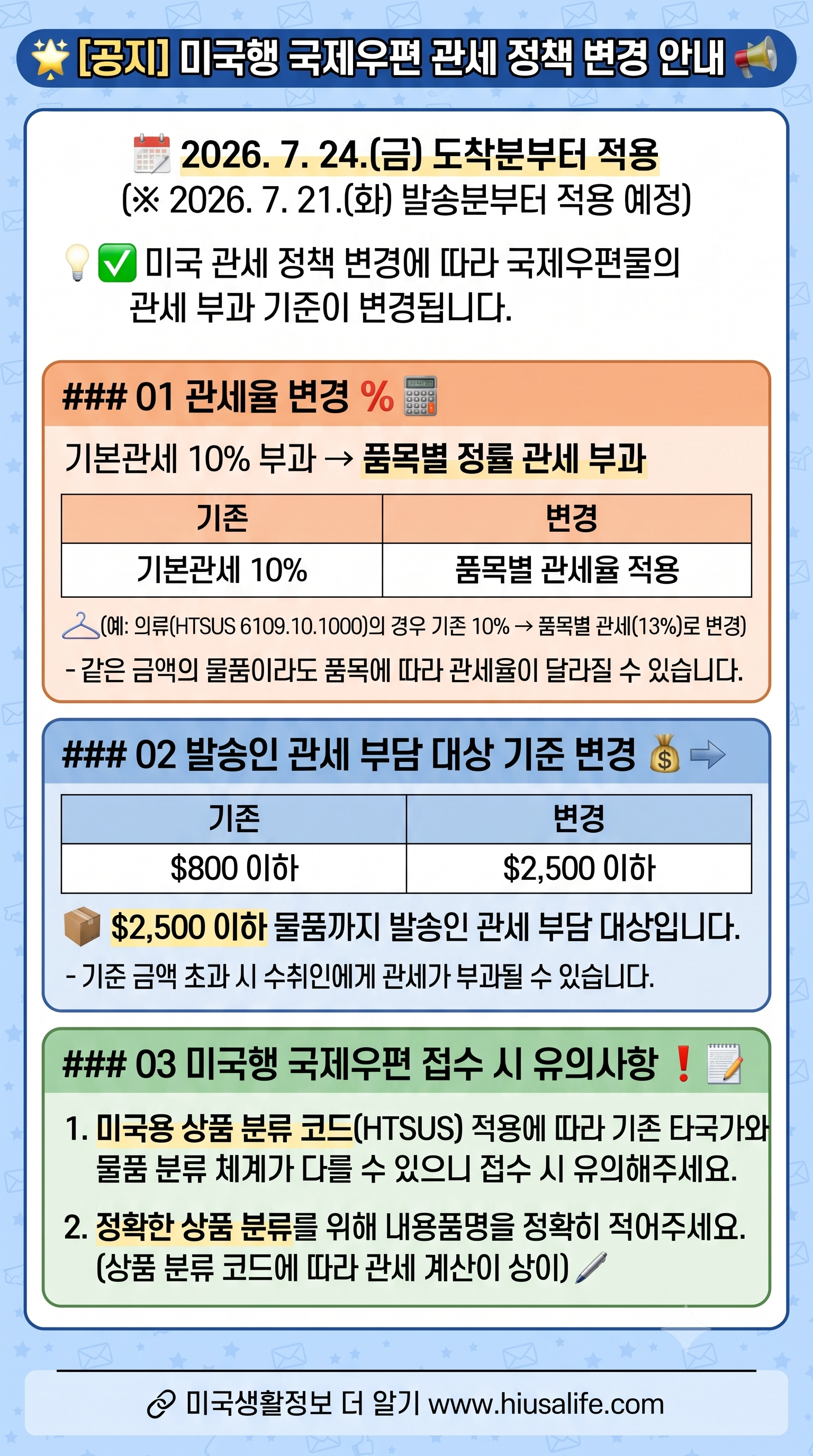
The value limit for parcels where the sender prepays duty rose from $800 to $2,500. For essentially every family package, that means whoever ships it in Korea pays the duty at the post office counter, and nothing is owed at your door. Above $2,500, the bill goes to the recipient in the U.S.
Related to this: under the new postal process, CBP officers no longer prepare entry paperwork by hand and duties are not collected at delivery. If a carrier asks you to pay cash at the door for a mailed parcel under $2,500, ask questions before paying.
Change 5: The Customs Form Is Now Doing Real Work
Because the rate depends on classification and origin, the declaration decides the bill. Vague entries like gift, food, or clothes can produce a wrong classification, a higher rate, or a hold. Ask whoever is shipping to write the specific item, material, quantity, honest value, HS code, and country of origin — cotton T-shirt, 2 pcs, Korea rather than clothing. Korea Post now requires senders to sign a consent form at the counter and to enter the HS code and origin, so the person mailing it will be asked for this anyway.
What Is Still Moving
- The postal entry process is still phasing in. The interim final rule took effect July 24, with a compliance date of October 22, 2026 for certain provisions. Filers are limited to the owner, purchaser, or a licensed customs broker, who must transmit a monthly spreadsheet with 10-digit HTSUS codes and pay through Pay.gov by the seventh of the following month, backed by a customs bond.
- A voluntary electronic test (Entry Type 13) for mail shipments valued at $2,500 or less begins September 22, 2026.
- The Section 122 litigation is unresolved. The Court of International Trade held the surcharge invalid on May 7, 2026; the Federal Circuit stayed that ruling and the appeal continues. Refunds are a live question for commercial importers, not for household parcels.
- The statutory repeal is already scheduled. Under the One Big Beautiful Bill Act, the de minimis exemption terminates by statute on July 1, 2027 — so this is not going back to how it was.
💡 Tip: Timing is based on when a parcel arrives, not when it ships. Keep the tracking number and the receipt from the Korean post office — that receipt is your proof of declared value. If a duty bill shows up and the value looks wrong, dispute it with the carrier rather than paying it on the spot.
Related reading: Shipping 101: USPS vs. UPS vs. FedEx · The New 1% U.S. Remittance Tax
General information as of August 2026, based on CBP interim final rules published June 24, 2026, the USTR Section 301 final action effective July 24, 2026, and Korea Post notices. Tariff policy is changing quickly and this is not customs or legal advice — confirm current rules with the shipping post office, the carrier, or U.S. Customs and Border Protection (cbp.gov) before sending anything.
#Customs #Tariffs #ShippingFromKorea #Section301 #DeMinimis #GiftExemption #LivingInUSA #KoreaPost #ImportDuty #hiusalife
한국에서 오는 국제우편 관세, 7월 24일 이후 실제로 어떻게 바뀜나

2026년 8월 18일 업데이트 — 이 글은 예고가 아니라 7월 24일 시행 이후 실제로 적용되고 있는 내용입니다.
한국에서 부모님이나 가족이 보내주시는 택배, 2026년 7월 24일 도착분부터 제도가 바뀌었습니다. 거의 모든 물품에 붙던 10% 일괄 관세는 없어졌고, 바로 그 자리에 다른 관세가 들어왔습니다. 지금 기준으로 정리하고, 가족 택배에 가장 중요한 — 그리고 의외로 잘 알려지지 않은 — 면세 조항도 같이 알려드릴게요.
변화 1: 10% 일괄 관세는 끝났고, 그 자리를 Section 301이 채웠습니다
2026년 2월 「1974년 무역법」 제122조로 도입됐던 한시적 10% 추가관세는 법이 정한 150일 한도를 채우고 7월 24일 동부 시간 0시 1분에 자동 만료됐습니다. 의회가 연장하지 않았고, 행정부 단독으로 연장할 수도 없는 조항이었습니다.
그런데 공백은 없었습니다. 똑같은 시각에 미국무역대표부(USTR)의 Section 301 강제노동 관세가 발효했습니다. 60개 경제권을 대상으로 10% 또는 12.5%를 추가 부과하는 조치로, 미국 수입의 약 99.4%를 덮습니다. 차이가 중요합니다. 제122조는 150일이라는 만료일이 법에 박혀 있었지만, Section 301은 만료일이 없습니다. 변경·철회되거나 법원이 무효화하기 전까지 계속 유지됩니다.
변화 2: 한국 물품은 12.5%만 기억하세요
한국은 일본·스위스와 같은 분류로 묶였습니다. 기존 최혜국(MFN) 관세와 새 Section 301 관세를 합쳐서 12.5%가 상한입니다. 풀어 쓰면 이렇습니다.
- MFN 관세가 2.5%인 품목 → 10% 추가 → 총 12.5%
- MFN 관세가 0%인 품목 → 12.5% 전액 부과
- MFN 관세가 이미 12.5% 이상인 품목 → Section 301 추가 부과 없음
놀라시는 부분이 하나 있습니다. 관세는 보낸 나라가 아니라 원산지 기준입니다. 서울에서 부친 박스라도 안에 중국산 물건이 들어 있으면 중국 세율이 적용됩니다 — 강제노동 관세 12.5% 정률에, 기존에 있던 중국전용 Section 301 관세까지 격달로 붙습니다. 한 상자에 여러 원산지가 섞여 있으면 가장 높은 세율을 각오하셔야 합니다.
🇰🇷 변화 3: $100 이하 선물 면세는 그대로 살아 있습니다
이 글에서 가장 쓸모있는 대목입니다. 2026년 6월 미국 관세국경보호청(CBP)이 무기한 정지한 것은 $800 소액면세(디미니미스), 즉 관세법 제321조 (a)(2)(C)항 하나뿐입니다. 선물 면세는 같은 조문의 다른 항목인 19 U.S.C. 1321(a)(2)(A)에 들어 있고, CBP는 두 개의 임시최종규칙 본문과 공식 FAQ에서 이 조항은 변함이 없다고 명시했습니다.
즉, 해외의 개인이 미국의 개인에게 보내는 $100 이하의 진짜 선물은 여전히 무관세입니다. 조건(19 CFR 10.152–10.153)은 까다롭지만 상식적입니다.
- 개인이 개인에게 대가 없이 준 진짜 선물이어야 합니다. 본인이 주문해서 본인 주소로 받는 물건은 해당되지 않습니다
- $100 한도는 수취인 1인·1일 기준입니다. 같은 날 같은 사람에게 도착한 세 박스는 합산됩니다
- 세관신고서에 선물(gift)로 표기하고 내용품과 가격을 정직하게 적어야 합니다
$300짜리를 $100씩 세 번에 나눠 보내는 식으로 피해가려는 건 합산 규정이 막기 위해 존재하는 방식이고, 가격을 낮춰 적는 건 또 다른 문제가 됩니다. 하지만 어머니가 보내주시는 $80짜리 밑반찬 박스나 생일 선물은 지금도 관세 없이 들어옵니다.
변화 4: $2,500까지는 보내는 분이 한국에서 정산
발송인이 관세를 선납하는 기준 금액이 $800에서 $2,500으로 올라갔습니다. 사실상 모든 가족 택배가 여기 들어가므로, 한국에서 보내는 분이 우체국 창구에서 관세까지 내고, 미국에서 받을 때는 추가로 낼 게 없습니다. $2,500을 넘으면 미국 수취인에게 청구됩니다.
연관된 변화가 하나 더 있습니다. 새 제도에서는 CBP 직원이 수작업으로 통관 서류를 만들지 않고, 배달 현장에서 관세를 걷지 않습니다. $2,500 이하 우편물인데 문앞에서 현금을 요구받으셨다면, 내기 전에 먼저 확인하세요.
변화 5: 세관신고서가 사실상 세금 신고서가 됐습니다
세율이 품목분류와 원산지로 결정되기 때문에, 신고서 한 장이 금액을 좌우합니다. ‘선물’, ‘식품’, ‘옷’ 같은 두루뭉술한 표기는 엉뚱한 분류로 이어져 세율이 올라가거나 통관이 보류될 수 있습니다. 보내시는 분께 구체적인 품목명, 소재, 수량, 정직한 가격, HS코드, 원산지를 적어달라고 부탁하세요 — ‘의류’가 아니라 ‘면 티셔츠 2매, 한국산’처럼요. 현재 우체국은 미국행 접수 시 창구에서 사전 동의서를 받고 HS코드·원산지 기재를 요구하고 있어서, 보내시는 분은 어차피 이 정보를 적어야 합니다.
아직 움직이고 있는 부분
- 새 우편 통관 절차는 아직 적용 중입니다. 규칙은 7월 24일 발효했지만 일부 조항의 준수 기한은 2026년 10월 22일입니다. 신고 주체는 물품의 소유자·구매자 또는 면허 관세사로 제한되고, 10자리 HTSUS 코드가 들어간 월간 명세를 제출해 다음 달 7일까지 Pay.gov로 납부해야 하며 관세 보증(bond)도 필요합니다
- 전자 간이통관 시범사업(Entry Type 13)이 $2,500 이하 우편물을 대상으로 9월 22일 시작됩니다
- 제122조 소송은 진행 중입니다. 국제무역법원(CIT)은 5월 7일 해당 추가관세를 무효로 판단했지만 연방순회법원이 집행을 정지시켜 항소가 계속되고 있습니다. 환급 문제는 상업 수입업체의 주제로, 가족 택배와는 상관이 없습니다
- 법으로 이미 예정된 종료일이 있습니다. One Big Beautiful Bill Act에 따라 소액면세 제도는 2027년 7월 1일부로 법적으로 종료됩니다. 예전으로 돌아가지는 않는다는 뜻입니다
💡 팁: 기준은 발송일이 아니라 도착일입니다. 송장번호와 한국 우체국 영수증을 보관하세요 — 그 영수증이 신고가액을 증명하는 자료입니다. 관세 고지서가 왔는데 금액이 이상하다면 그 자리에서 내지 말고 배송업체에 이의를 제기하세요.
함께 읽으면 좋은 글: 미국 배송 기초: USPS vs UPS vs FedEx · 미국 1% 송금세 정리
2026년 8월 기준 일반 정보이며, 2026년 6월 24일 공표된 CBP 임시최종규칙과 7월 24일 발효한 USTR Section 301 최종조치, 우체국 공지를 바탕으로 정리했습니다. 관세 정책은 빠르게 바뀌고 있고 이 글은 관세·법률 자문이 아닙니다. 발송 전에 우체국, 배송업체, 또는 미국 관세국경보호청(cbp.gov)에서 최신 규정을 확인하세요.
#미국관세 #국제우편관세 #한국택배 #디미니미스 #선물면세 #미국생활 #미국생활정보 #해외배송 #우체국 #hiusalife
댓글 남기기